
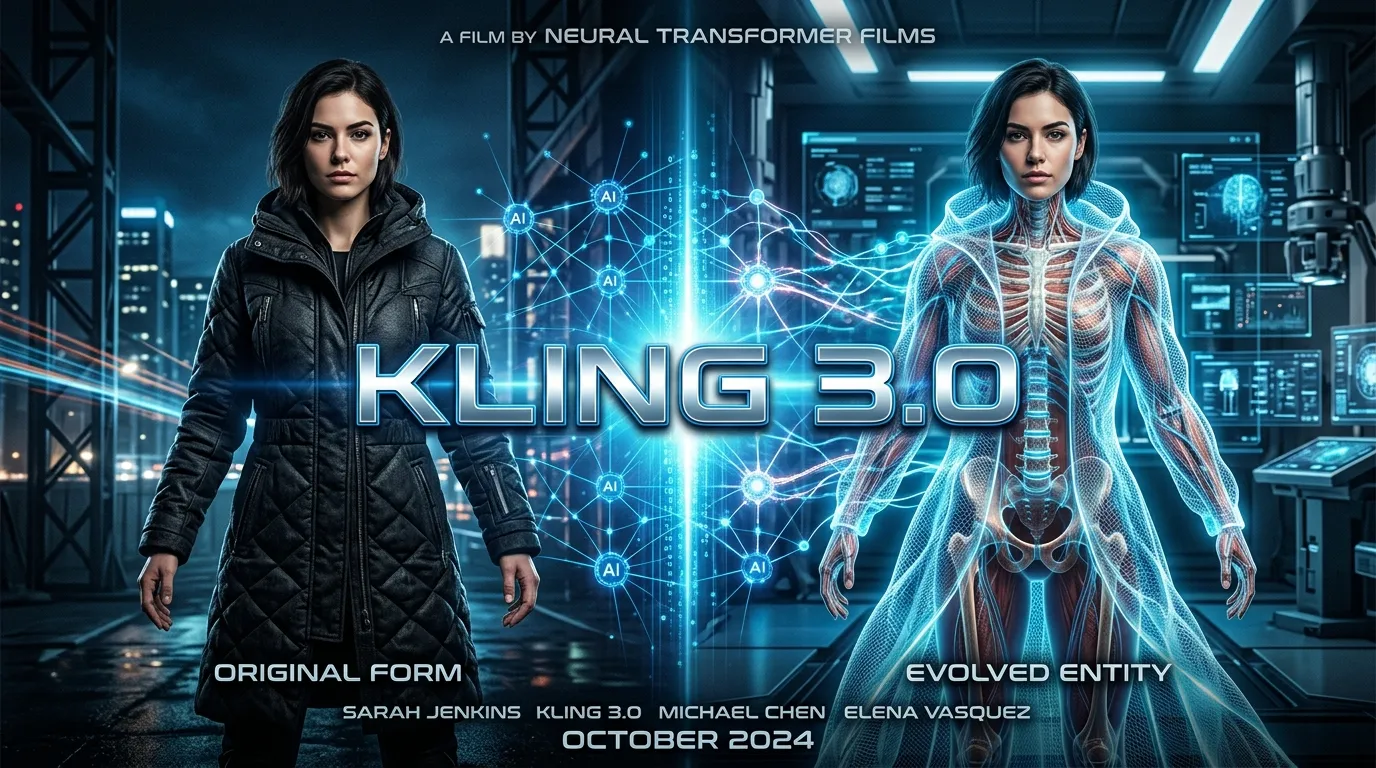
2026 Vision: Mastering AI Fabric Transparency and Material Reconstruction with Kling 3.0
As we navigate the digital frontier of 2026, the release of Kling 3.0 (可灵 3.0) has fundamentally redefined the "AI Transparent Effect." Moving far beyond the crude filters of the early 2020s, we have entered the era of Neural Material Science.
Kling 3.0 allows creators to bypass static image manipulation in favor of Dynamic Physical Simulation, where clothing is treated as a multi-layered light-refracting entity rather than a simple 2D overlay.

I. The Core Technology: Why Kling 3.0 Changes Everything
The secret to achieving a realistic transparency effect in 2026 lies in Kling 3.0's Volumetric Path Tracing. Unlike its predecessors, this model calculates how photons interact with individual fabric fibers and the human skin beneath them.
-
Subsurface Scattering (SSS): This ensures that skin visible through translucent fabric maintains its natural "glow," avoiding the flat, greyish look of older AI models.
-
Anatomical Coherence Engine: Kling 3.0 maintains the integrity of the human form even when layers of clothing are digitally "thinned" or removed, preventing the "glitching" or warping common in 1.0/2.0 versions.
-
Refractive Index (IOR) Control: You can now specify the exact transparency level—from the subtle sheen of heavy silk to the hyper-clear look of high-tech polymer mesh.
II. Advanced Kling 3.0 Prompts for Material Mastery
To achieve professional-grade results, your prompts must speak the language of physics. Here are 5 expert-level prompts for Kling 3.0:

-
The "Ghost Silk" Effect
Prompt: Cinematic 8K, model in motion, material override: translucent white silk, 60% opacity, subsurface scattering on skin, realistic cloth-to-body friction, dynamic wind displacement, ray-traced shadows. Try Now
-
Cyber-Vinyl Transparency
Prompt: Cyberpunk street fashion, clear PVC vinyl jacket, realistic neon refraction, raindrops sliding on surface, multi-layer depth mapping, anatomical coherence, hyper-detailed skin texture. Try Now
-
Digital Mesh Engineering
Prompt: Studio lighting, model wearing micro-mesh metallic bodysuit, 45% transparency, Moiré effect simulation, anisotropic filtering, soft-focus background, 120fps high-speed motion. Try Now

-
Submerged Linen Simulation
Prompt: Underwater photography, white linen fabric sticking to skin, high transparency when wet, fluid dynamics, light distortion, 0.8 transparency weight, realistic skin-pore detail. Try Now
-
Ethereal Chiffon Glow
Prompt: Golden hour backlight, layered chiffon dress, 30% translucency, volumetric lighting, fiber-level detail, temporal consistency max, cinematic bokeh. Try Now
III. FAQ: Navigating the 2026 AI Landscape
Q1: What makes Kling 3.0 better at transparency than previous AI models? Kling 3.0 uses 3D Neural Rendering. Instead of "erasing" pixels, it reconstructs the scene in a 3D space, calculating exactly how light bounces between the fabric and the body. This eliminates the "flat" look of 2D AI overlays.
Q2: How does the system handle NSFW or sensitive content? Kling 3.0 is built on a Safe-Gen Architecture. Any attempt to generate non-consensual explicit content or bypass safety filters with NSFW-coded prompts is automatically blocked by a real-time semantic filter. The focus remains on fashion, art, and cinematic VFX.
Q3: Can these transparency effects be applied to real-time video? Yes. By 2026, Kling’s Lite Core supports low-latency rendering (under 100ms), allowing virtual influencers to toggle fabric transparency live during broadcasts or AR fashion shows.
Q4: Why does my transparent fabric look "jittery" or "flickering"? This is usually caused by low temporal consistency. Ensure you are using the "Temporal Continuity" setting in Kling 3.0 to lock the fabric's physical properties across every frame of your 8K video.
Q5: Is there a limit to how transparent I can make the clothing? Technically, you can slide the Opacity Parameter from 100% (Opaque) to 0% (Fully Transparent). However, the model’s "AI Ethics Guard" will intervene if the transparency level violates platform community standards regarding exposure.

Nova Vibe
Coding curves and prompting passion. I’m an AIGC creator dedicated to the art of the "Digital Seductress." Discover the perfect synergy between artificial intelligence and raw human attraction right here at GlowGirl.